
Life in the A-Frame

Showing posts with label gardening. Show all posts
Showing posts with label gardening. Show all posts
Tuesday, December 4, 2012
my garden in December


Monday, November 12, 2012
How big did it get?
I finally picked my "Giant" pumpkin from the garden. I thought that it had reached its maximum size. It weighed 22 pounds (less than I thought) and measured 45 1/2 inches around from stem to end (oblong). The circumference right around the middle was 35 3/4 inches.
It now sits on this table in my living room. I think it will be the centerpiece on Thanksgiving. It was a lot of fun watching it grow in the garden. Next year, I will get an earlier start in planting the seeds and see if we can grow one a little larger for next Fall.

Thursday, October 18, 2012
My "Giant" Pumpkin
I am still producing 3 kinds of peppers and some okra in my garden. I think that is amazing for this time of year. I also have lots of basil, lavender and fennel. The tomatoes are producing again since the weather has cooled. My favorite little project is this pumpkin. Just for fun I planted 2 giant pumpkin seeds at the end of June-very late in the season. The two vines made one pumpkin each but I soon lost one of the vines. This one survived the hot, dry summer and is beginning to ripen. I will measure it soon and give an update. It has a very oblong shape and it is a good 2 feet long from stem to stem.


Sunday, November 6, 2011
Making my indoor garden
A few weeks ago, I started some plants outdoors. The weather has been very warm over all but we did get a few nights with temperatures in the 30's. I moved the plants inside and hope they will continue to produce.

I have mixed lettuces.

Basil

Kale

and spinach

I picked a variety of the greens. I got a surprising amount for the first picking.

I cooked some hot Italian sausage, onion, mushrooms and garlic together. Then I added the greens I picked and some crushed tomatoes. For supper, we had lentils topped with sausage and greens. It was wonderful-and fun to add the fresh greens that I grew myself. I still need to pick over half the lettuce and a lot of the spinach. That means we will have a fresh salad tonight.
Wednesday, June 15, 2011
Wild, Native Sunflowers
These native sunflowers voluntarily came up in our Church garden. They are easily 6-7 feet tall. I'm glad we left them where they were. They are providing shade to some of the cucumbers and squash and we've tied some of the tomatoes to them for support. Now they have all bloomed and the seeds are ripening and will soon draw lots of birds to this area.


Monday, June 13, 2011
The Albino Zucchini

Sunday, May 15, 2011
Change the World event update

Tuesday, May 10, 2011
Change the World Day: a church project
We decided this year to have our very first Church garden. We wanted to grow fresh vegetables and donate them to local food kitchens. So far, it is doing very well, considering the weather around here. The United Methodist Church is having a "Change the World" weekend (May 14-15) and our potatoes happen to be ready to harvest. You can get more information about this event here:
Change the World
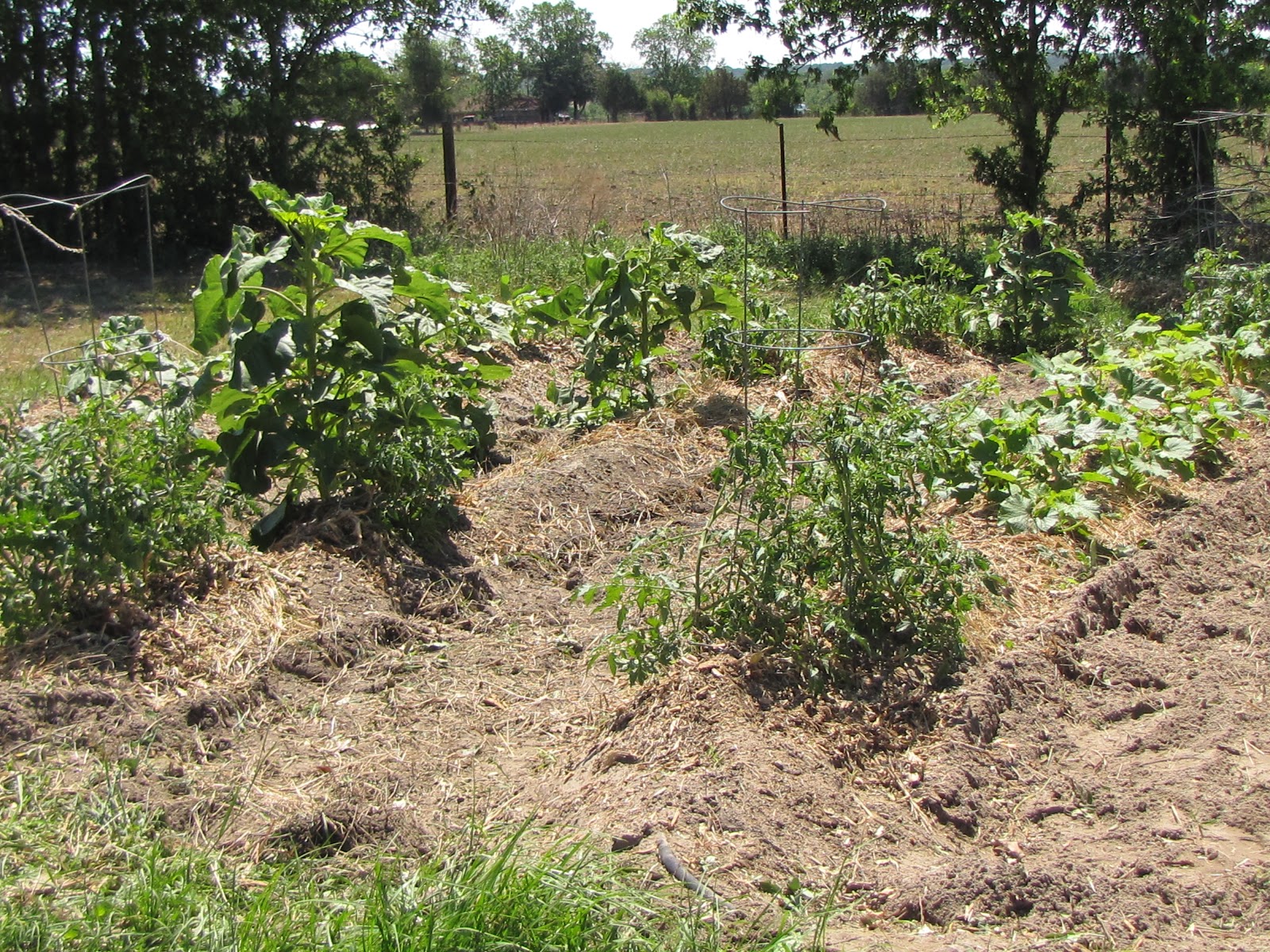
 Tomatoes and squash are growing and starting to bloom. The largest plants are voluntary wild sunflowers, and we just left them where they were.
 Onions and potatoes are ready to harvest.

 Mike and I are retired, so we spent quite a bit of time helping with the garden. Mike is so good about doing a lot of the heavy work like moving dirt and mulch with the wheel barrow and using the tiller. Here we are adding more mulch to the rows. A soaker hose system makes it a lot easier to water the plants. We are trying to do this as environmentally efficient as possible. We don't want to waste water and other resources. Also, we want the garden to be organic, so we don't use pesticides or herbicides either.
If you would, please pray for the success of the garden, so that it can produce much needed, healthy food items. Also, please pray that the ideas behind "Change the Word" weekend will spread across the world. That way, with the help of many others, we can make a difference.
Thank you! I'll report back after next Saturday and let you know how our potato harvest went.
Change the World
What if one weekend all around the world, 11 million United Methodists focused on finding sustainable solutions to hunger? Change the World: May 14 - 15, 2011
Let's see if we can make a difference.


If you would, please pray for the success of the garden, so that it can produce much needed, healthy food items. Also, please pray that the ideas behind "Change the Word" weekend will spread across the world. That way, with the help of many others, we can make a difference.
Thank you! I'll report back after next Saturday and let you know how our potato harvest went.
Monday, March 21, 2011
A look underneath
Once again, the ordinary becomes extraordinary when observed from a new perspective. I wanted to see if I could capture the translucence of the light from the sun.
Translucent means"Transmitting light but causing sufficient diffusion to prevent perception of distinct images". Yes, I looked that up too.
Lemon petunia. Very translucent.


A marigold. Not as translucent as the petunia.


Sunday, March 20, 2011
A look inside
I took a close-up look at my new lemon petunias. I think they are so pretty, a fresh lemon color.

I marveled at the veins in the petal and the tiny pistil and stamens. I looked it up and found out that this green part in the middle is the pistil, which contains the stigma, style and ovary. The brown edged structures are the stamens. They are made of the anther and filament. These are the reproductive parts of the flower.

Sunday, February 6, 2011
A Little Summer in Winter

Last August, during another drought, I tansfered a couple of tomato plants from the garden into some containers on the porch. When Fall came and the weather got cold, I moved the plants into my sunroom. Well they kept growing....and producing.

I was trying to get a little perspective in these photographs. I don't know if you can tell, but these tomato plants are now over 6 feet tall.

Here's my crop from the other day. The cayenne peppers are producing too. It was enough to add to our salad for supper. In additon to the tomatoes and peppers, I also have a large sweet potato vine and a spinach vine.The green plants and the colorful little crops brighten some fairly gloomy days. Later in the Spring, I'll replant them in the garden.
If I am organized enough,
I'd like to have an entire Winter garden in my sunroom next year. Anyone else?
Wednesday, September 29, 2010
Simple Beauty


Apparently, something as simple as a squash blossom can be complex and beautiful....if you really look at it.
Thursday, September 23, 2010
My Mama would be proud

My internet research shows:
Health benefits of Purslane
■This wonderful green leafy vegetable is very low in calories (just 16 kcal/100g) and fats; but is rich in dietary fiber, vitamins and minerals.
■Fresh leaves contain surprisingly more Omega-3 fatty acids (α-linolenic acid) than any other leafy vegetable plant. 100 grams of fresh purslane leaves provides about 350 mg of α-linolenic acid. Research studies shows that consumption of foods rich in ω-3 fatty acids may reduce the risk of coronary heart disease, stroke and also help prevent development of ADHD, autism, and other developmental differences in children.
■It is an excellent source of Vitamin A, (1320 IU/100 g, provides 44% of RDA) one of the highest among green leafy vegetables. Vitamin A is a known powerful natural antioxidant and is essential for vision. This vitamin is also required to maintain healthy mucus membranes and skin. Consumption of natural vegetables and fruits rich in vitamin A known to help to protect from lung and oral cavity cancers.
■Purslane is also a rich source of vitamin C, and some B-complex vitamins like riboflavin, niacin, pyridoxine and carotenoids, as well as dietary minerals, such as iron, magnesium, calcium, potassium and manganese.
■Also present in purslane are two types of betalain alkaloid pigments, the reddish beta-cyanins and the yellow beta-xanthins. Both of these pigment types are potent anti-oxidants and have been found to have anti-mutagenic properties in laboratory studies. [Proc. West. Pharmacol. Soc. 45: 101-103 (2002)]
Sweet Potato Leaves
Cholesterol - This is one of the healthy foods if you're watching your Cholesterol intake. There are 0 mg of Cholesterol
Carbohydrates - Total Carb count for one serving: 2.23 grams. Sugar: Unknown, Fiber: 0.7 grams, and Net Carbs: 1.5 grams (helpful to know if you're counting carbs).
Protein - For Protein, one serving of this food has a total of 1.4 grams.
Minerals - In one serving there are 12.95 mg of Calcium and 0.35 mg of Iron. In addition, there are 3.15 mg of Sodium and 181.3 mg of Potassium in this food.
Vitamins - You'll benefit from both Vitamins C and A with this food. There are 3.85 mg of Vitamin C and 359.8 International Units of Vitamin A in each serving.
Calories in Squash Blossoms
Nutritional AnalysisGood points
Low in sodium
High in calcium
High in iron
Very high in vitamin A
Very high in vitamin C
VERY WORTHWHILE, DON'T YOU THINK?
Monday, July 26, 2010
Miniature Crop

Saturday, May 15, 2010
First crop of the year!
Some of my yellow summer squash were big enough to pick and I always celebrate the first squash or okra by frying it up for supper. So simple, and so delicious. Just cut the squash into thin circles, rinse with water, coat with cornmeal, salt and pepper. Then fry in hot oil until the cornmeal is very golden and crispy.


Thursday, April 30, 2009
Sweet rain, sweet produce
 We have had a period of really nice rain and it definitely shows in the garden. I picked some of my Kentucky Wonder Stringless Green beans today. I picked some green onions and then moved my lettuce into a container and placed it in the shade on the deck because it had gotten too hot for it in the garden. I took the beans and onions, cut them up, added bacon, and new red potatoes for part of our supper.
Mike is grilling some more pork chops (am I starting a pork chop Thursday tradition?) but we are all out of the GOOD BBQ sauce. Store bought will have to do. I'm adding fresh tomatoes and romaine lettuce to finish our feast.
Tuesday, March 31, 2009
From the garden to the table
 My first salad from the garden started out as mild, green leaves-slightly covered with sand because we have finally gotten a little rain.
 Ten minutes later, the leaves were double washed and ready for our supper salad!
Saturday, March 7, 2009
It is the little things that are important right now
 Baby Garden...
 Garden Baby
It is nice to be at home, with things getting back to a normal routine. Thank you to everyone for the thoughts and prayers. It is good to be back.
Friday, October 10, 2008
My limes are really lemons after all
 Back in the Spring, I bought a Meyer lemon tree and it produced fruit. On June 29, I wrote a post about my family's concerns that it was a lime tree, not a lemon. Even I had my doubts when, month after month, the fruit remained bright green. Even when they measured about 3 inches in diameter, they were solid green. After consulting the internet, I was reassured that a Meyer lemon ripens in late October or November. Yes! They are turning yellow and getting ripe. Soon I'll pick them and make something for Christmas (limoncello?)out of them. After all, these are special fruit. It takes a long, long time to grow a Meyer lemon.
Uh Oh-I looked up the following recipe and I'll be cutting it really close if I try to make limoncello for Christmas gifts. It takes 80 days and 15 lemons-I have 11. I'll let you know if this works out.
From:Whatscookingamerica.net
If you have ever been to Italy, you'll instantly know about Limoncello. It is a lemon liqueur that is served well chilled in the summer months. It is wonderful as a palate cleanser or as an after dinner drink. Keep your bottles of limoncello in the freezer until ready to serve. The ingredients are simple and few, and making a batch doesn't require much work, but you'll need some time. Limoncello must steep for (80) eighty days
Italian Limoncello
15 lemons* 2 bottles (750 ml) 100-proof vodka** 4 cups sugar 5 cups water
* Choose thick-skinned lemons because they are easier to zest.
** Use 100-proof vodka, which has less flavor than a lower proof one. Also the high alcohol level will ensure that the limoncello will not turn to ice in the freezer.
Step One:
Wash the lemons with a vegetable brush and hot water to remove any reside of pesticides or wax; pat the lemons dry.
Carefully zest the lemons with a zester or vegetable peeler so there is no white pith on the peel. NOTE: Use only the outer part of the rind. The pith, the white part underneath the rind, is too bitter and would spoil your limoncello.
Step Two:
In a large glass jar (1-gallon jar), add one bottle of vodka.
Add the lemon zest as it is zested.
Cover the jar and let sit at room temperature for at least (10) ten days and up to (40) days in a cool dark place. The longer it rests, the better the taste will be. (There is no need to stir - all you have to do is wait.) As the limoncello sits, the vodka slowly take on the flavor and rich yellow color of the lemon zest.
Step Three:
In a large saucepan, combine the sugar and water; cook until thickened, approximately 5 to 7 minutes.
Let the syrup cool before adding it to the Limoncello mixture.
Add to the Limoncello mixture from Step One. Add the additional bottle of vodka. Allow to rest for another 10 to 40 days.
Step Four:
After the rest period, strain and bottle: discarding the lemon zest.
Keep your bottles of Limoncello in the freezer until ready to serve.
Thursday, October 9, 2008
profusion in all its (morning) glory

Profusion Explosion Proliferation Abundance Wealth Heaping Bounteous Plentiful Cornucopia
Subscribe to:
Posts (Atom)